
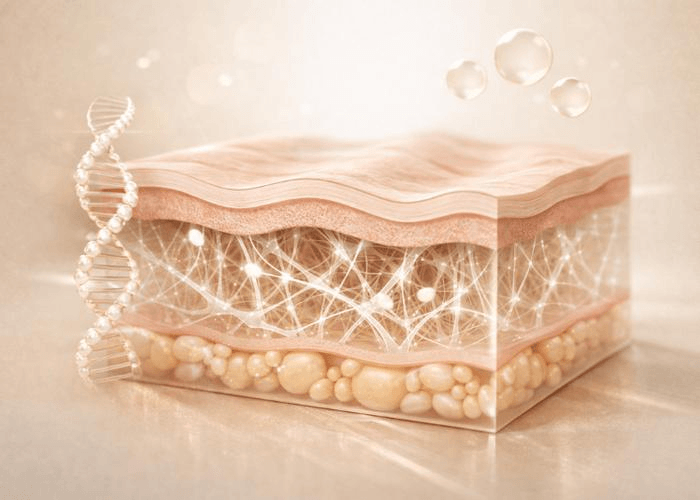
If you’ve looked into skin ageing or joint support recently, you’ve likely come across collagen peptides. This guide covers what collagen peptides are, their possible uses and side effects, the different types available, and how they may support skin health.
What Are Collagen Peptides?
Collagen peptides are small protein fragments created by breaking down whole collagen through a process called hydrolysis. Collagen itself is the most abundant structural protein in the human body, forming the scaffolding of skin, bones, tendons, ligaments, and cartilage.
Because collagen molecules are too large to be absorbed efficiently when eaten whole, manufacturers break them down into shorter chains of amino acids. This process, known as hydrolysis, produces hydrolysed collagen, or collagen peptides, which the body can absorb more readily through the digestive tract. Once absorbed, these peptides act as building blocks and signalling molecules, supplying amino acids such as glycine, proline, and hydroxyproline that the body uses in its own collagen production. Collagen peptides work on the same underlying biological pathway as peptides used in topical skincare, though the oral and topical routes reach the skin differently.
Collagen peptides are most commonly sourced from bovine (cattle), porcine (pig), or marine (fish) collagen, and are typically sold as a flavourless powder that dissolves into drinks, or as capsules.
Uses of Collagen Peptides
Collagen peptides are primarily used as a daily dietary supplement to support skin, joint, and connective tissue health. They are not a medical treatment and are not regulated as a therapeutic good in the same way as prescription medicines.
What the research suggests
Skin ageing. Oral use appears to support improvements in hydration, elasticity, and skin texture over consistent daily use.
Dry skin. Oral use appears to support skin hydration, likely by boosting moisture retention in the outer skin layer.
Side Effects of Collagen Peptides
Collagen peptides are generally considered to have a favourable safety profile.
Common side effects
The most frequently reported side effects relate to digestion. Mild bloating, a feeling of fullness, or occasional loose stools can occur in the first one to two weeks of use, generally affecting a small percentage of new users and often resolving as the body adjusts. Some people also report a lingering aftertaste, particularly with unflavoured or marine-sourced products.
Allergic reactions
Allergic reactions to collagen peptides are uncommon but possible, particularly in people with an existing allergy to the source protein. Marine collagen carries the highest documented risk, since individuals with fish or shellfish allergies can react to marine-derived peptides even after processing. Reported symptoms include hives, skin rashes, itching, and in rare cases, swelling or difficulty breathing. Anyone who suspects an allergic reaction should stop use immediately and seek medical advice.
Precautions before taking collagen peptides
Certain groups should take extra care or consult a healthcare provider before starting collagen peptides. If you have chronic kidney disease, speak with your own healthcare provider before taking collagen peptides, as they can advise whether a protein supplement is appropriate for you. People with known allergies to bovine, porcine, or marine proteins matching the collagen source should also take care. Collagen peptides have not been well studied in children, and pregnant or breastfeeding women should check with a healthcare provider before use, since safety data specific to these groups remains limited.
Different Types of Collagen Peptides
At least 28 distinct types of collagen have been identified in the human body. All share a common building block, a repeating amino acid sequence that folds into a triple helix structure, but each type is assembled differently and serves a distinct role depending on where it’s found. Supplements typically draw on five key types.
Type I collagen
Type I collagen is by far the most abundant, accounting for roughly 90% of the body’s total collagen. Its densely packed fibres give structural support to skin, bones, tendons, and ligaments, and it’s the type most closely tied to skin firmness and elasticity.
Type II collagen
Type II collagen has a looser, more flexible fibre arrangement and is the main structural component of cartilage, the tissue that cushions and supports joints.
Type III collagen
Type III collagen is the second most abundant type in the body and is often found alongside Type I. It forms thin, branching fibres concentrated in blood vessels, muscles, and organ tissue, and plays a notable role in the early stages of wound healing before Type I collagen takes over as tissue matures.
Type IV collagen
Type IV collagen doesn’t form long fibres the way other types do. Instead, it forms sheet-like layers found within the skin’s structure, contributing to its underlying architecture.
Type V collagen
Type V collagen appears in smaller amounts throughout the body, including the cornea, layers of skin, hair, and placental tissue. It works alongside Type I, helping regulate the size and organisation of collagen fibres.
How Collagen Peptides Support Skin Health
The role of collagen in healthy skin
Collagen forms the structural framework of the dermis, the layer of skin beneath the surface that gives skin its firmness and elasticity. As collagen fibres age or become damaged, skin can lose density and elasticity, contributing to the fine lines and reduced firmness commonly associated with skin ageing. Collagen production naturally declines with age, which is one reason skin changes become more noticeable over time.
How collagen peptides work
Once absorbed, collagen peptides are broken down into amino acids and smaller bioactive peptide fragments that can act as signalling molecules in the body. Research suggests these fragments may stimulate fibroblasts, the cells responsible for producing new collagen, and increase collagen deposition in the dermis (Kim et al., 2018, Nutrients). This differs from topical collagen skincare products, which sit on the skin’s surface, since ingested collagen peptides are absorbed systemically and distributed through the bloodstream to tissues throughout the body. It also differs from in-clinic approaches such as PRP and PRF, which use your own blood’s growth factors to stimulate fibroblasts directly within the treated area rather than relying on systemic absorption.
Potential Skin Benefits
- Improved skin hydration
- Better skin elasticity
- Reduced appearance of fine lines and wrinkles
- Support for the skin barrier
- Improved skin texture
Factors That Affect Results
Age – Collagen production naturally declines with age, affecting how noticeable supplementation’s effects are.
Diet and protein intake – Adequate protein, vitamin C, zinc, and copper support the body’s ability to use collagen peptides effectively.
Sun exposure – UV light breaks down existing collagen and reduces new production, which can offset supplementation’s benefits.
Smoking – Smoking reduces blood flow to the skin and damages existing collagen, working against supplementation.
Daily skincare routine – Sun protection and supportive topical products complement oral collagen’s internal effects.
Consistent supplementation – Clinical trials have tested a range of doses. A randomised, placebo-controlled trial tested 2.5 g daily over 6 weeks and found greater improvement in skin hydration than placebo (Carrillo-Norte et al., 2024, Cosmetics). A randomised controlled study in hospitalised older adults tested an oral nutrition supplement containing 10 g of collagen peptides daily over 8 weeks and reported improved skin hydration compared with a control group (Nomoto & Iizaka, 2020, Advances in Skin & Wound Care). The degree of hydrolysis also affects absorption, so product quality matters alongside dosage.
Frequently Asked Questions
What are collagen peptides?
Collagen peptides are small, easily absorbed protein fragments produced by breaking down whole collagen through hydrolysis. They supply amino acids the body uses to support its own collagen production in skin, joints, and connective tissue.
Are collagen peptides the same as collagen?
Collagen peptides are derived from whole collagen but broken down into smaller, more bioavailable fragments through hydrolysis. This makes them easier for the digestive system to absorb compared with intact collagen protein.
Are collagen peptides worth taking?
This depends on individual goals and expectations. Clinical research has associated consistent daily use with measurable improvements in skin hydration and elasticity in several trials, though results vary between individuals and are influenced by dosage, consistency, and other lifestyle factors.
Can collagen peptides help wrinkles?
Some research has associated regular collagen peptide intake with improved skin elasticity and texture, which may contribute to a smoother appearance over time. Collagen peptides are not a medical treatment for wrinkles, and results vary between individuals.
When should I take collagen peptides?
Collagen peptides can generally be taken at any time of day, since consistency of daily use matters more than timing. Many people take them mixed into a morning drink as part of a routine to support adherence.
Are collagen peptides safe?
For most healthy adults, collagen peptides are considered to have a favourable safety profile, with mild digestive symptoms being the most commonly reported issue. People with kidney disease, known allergies to the collagen source, or who are pregnant or breastfeeding should consult a healthcare provider before use.
Collagen Peptides and Professional Skin Treatments
Oral collagen peptides work from the inside, gradually supporting the body’s own collagen production over weeks of consistent use. Professional in-clinic treatments work differently, targeting the dermis more directly to encourage a faster or more concentrated regenerative response.
Treatments such as PRP and PRF use your own blood’s growth factors to stimulate collagen-producing fibroblasts directly within the skin. Rejuran Salmon DNA uses polynucleotides to support the skin’s repair processes and improve texture and hydration. Medical-grade skin needling creates controlled micro-channels in the skin that trigger the body’s natural wound-healing and collagen-remodelling response, and can be combined with topical or injectable actives for enhanced effect. Skin bio-remodelling treatments similarly aim to improve hydration, firmness, and skin quality over a course of sessions. If you’re weighing up which of these regenerative options suits your skin concerns, a practitioner consultation can help you understand how each approach may suit your individual needs.
For people already taking collagen peptides as part of a daily routine, in-clinic regenerative treatments can complement that approach by addressing the dermis more directly, rather than relying on oral supplementation alone. A practitioner consultation is the most reliable way to understand which combination of options may suit your specific skin concerns, since suitability depends on individual skin condition, goals, and medical history.
Conclusion
Collagen peptides are a widely studied dietary supplement associated with potential improvements in skin hydration, elasticity, and texture, alongside broader uses for joint and connective tissue support. While generally well tolerated, they’re not free of possible side effects, and certain groups should seek medical advice before starting. Understanding the different collagen types and how peptides work in the body can help set realistic expectations about what oral supplementation can and can’t achieve, particularly compared with in-clinic regenerative treatments.
If you’re curious how collagen-focused skincare and professional treatments might work together for your skin goals, book a consultation with the team at Diamond Aesthetics, our skin clinic in Parramatta, to discuss your options.

0 Comments