
Peptides do not repair your skin. They tell your skin to repair itself.
The message they carry is mostly about collagen, the protein that keeps skin firm and smooth. A peptide reaches a skin cell and asks it to make more.
A microneedling treatment has already sent that same message, far more strongly. The treatment starts a repair process that carries on for weeks, long after your face looks and feels back to normal. Using a peptide serum through those weeks keeps the message arriving while your skin is still working on it.
That is the reason peptides suit this period. They are not doing something your skin cannot do on its own. They are backing up work that is already underway.
Where it goes wrong is timing. Your skin behaves differently in the first three days than at any other point, and the order you bring products back matters more than what you paid for them. This guide covers that order.
What Happens to Your Skin After Microneedling?
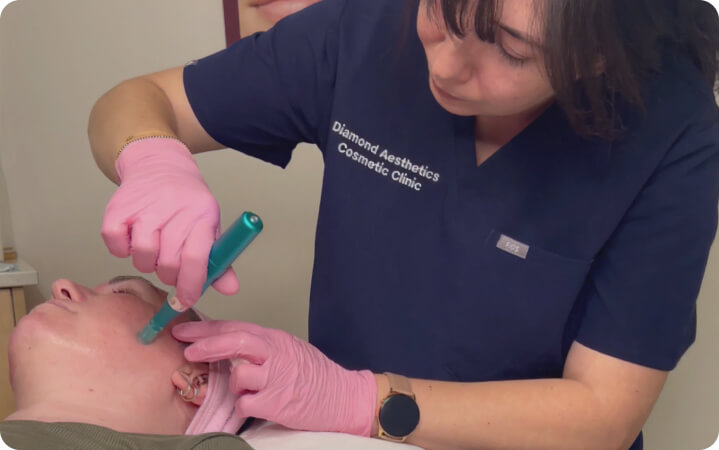
Microneedling creates thousands of tiny, controlled injuries in the skin. Your body reads them as wounds and begins repairing, which prompts fibroblasts, the cells that build collagen, to produce fresh collagen and elastin over the following weeks. It also leaves behind temporary channels and a barrier that is briefly weaker than usual.
Two things happen at once, and it helps to keep them apart.
On the surface, recovery is fast: Your barrier, which holds water in and keeps irritants out, is weakened for a short window. That is why your face feels tight and looks flushed. Research tracking water loss through treated skin found it peaked immediately after treatment, then eased back toward normal within two to three hours. Separate laboratory work found barrier function recovered within three to four hours, with the tiny channels closing at around fifteen hours when skin was left open to the air.
Underneath, the work takes far longer: Fibroblasts move in and lay down soft new collagen, which your body gradually swaps for the stronger kind over the following weeks. This is the part that actually changes your skin.
The surface seals within hours. The rebuilding carries on for a month or more. Everything you put on your face in between is landing on skin that looks recovered long before it has finished the job.
Here is what most people can expect, keeping in mind that no two recoveries run to the same schedule.
Immediately after treatment (0 to 24 hours): Skin may look flushed and feel warm, like mild sunburn. Minor swelling is common, especially around the eyes, and skin may feel tight or sensitive.
Days 2 to 3: Redness usually fades, though skin may feel dry and flake lightly as it sheds cells disrupted during treatment. Try not to pick. Breakouts around now usually come from richer products or occlusion, not from anything being drawn out of the skin.
Days 4 to 7: Most redness and swelling should have settled, though skin can stay sensitive. Some people notice changes in texture or brightness. Recovery differs from person to person.
The following weeks: Between weeks two and four many people find their skin settles and gradually changes in appearance. New collagen and elastin production can keep building for several months, though timing differs for everyone.
Remember: Everyone heals differently. Your age, skin type, the depth you were treated at, and how closely you follow aftercare guidance all affect both your timeline and your result.
Less common problems include infection, dark patches left behind after inflammation (more likely on medium and deeper skin tones), redness that lingers longer than expected, and reactions to products applied during or after treatment.
Call your clinic if you notice redness spreading, pain getting worse after the first day, pus or yellow crusting, blistering, fever, or a rash that turns up days later rather than straight away.
What Are Peptides?
Peptides are short chains of amino acids, usually two to ten units long. Amino acids are what your body builds collagen and elastin from, the proteins that keep skin firm and springy. In skin, peptides act as instructions, signalling cells to produce more of those proteins.
A peptide locks onto a receptor on a fibroblast, the cell that makes collagen, and prompts it to build. It does not add collagen itself. It asks your skin to make its own, which is why peptides work over weeks rather than days.
The word “peptide” alone does not tell you which job the ingredient is doing.
The Different Types of Peptides
Peptides fall into four groups, and each one carries a different instruction. Only two of them have any real business in your routine after microneedling.
Signal peptides are the collagen builders. They copy the fragments your body releases when collagen breaks down, which prompts your fibroblasts to produce more collagen, elastin and fibronectin, a protein that helps skin cells anchor where they should. Palmitoyl pentapeptide-4, sold as Matrixyl, is the best studied example.
Carrier peptides work as delivery vehicles. They ferry trace minerals into the skin, where those minerals switch on the enzymes that handle repair. Copper is the mineral that matters here, and GHK-Cu is the peptide that carries it.
Neurotransmitter-inhibiting peptides soften the appearance of expression lines by quietening the signal between nerve and muscle near the surface. Acetyl hexapeptide-8, marketed as Argireline, is the common one.
Enzyme-inhibiting peptides protect rather than build. They slow the enzymes that dismantle collagen you already have.
Peptide type | How it works | Common examples |
| Signal peptides | Mimic matrikine fragments, prompting fibroblasts to synthesise collagen, elastin and fibronectin | Palmitoyl pentapeptide-4 (Matrixyl), Matrixyl 3000, palmitoyl tripeptide-38 |
| Carrier peptides | Deliver trace minerals such as copper, which act as cofactors for repair enzymes | GHK-Cu (copper tripeptide-1) |
| Neurotransmitter-inhibiting peptides | Soften the appearance of expression lines by dampening muscle signalling near the surface | Acetyl hexapeptide-8 (Argireline) |
| Enzyme-inhibiting peptides | Slow the enzymes that break down collagen you already have | Tripeptide-10 citrulline, soy and rice-derived peptides |
For post-microneedling care, the first two groups earn their place, and the other two do not. Signal and carrier peptides work along the same pathway your treatment has already switched on, so they add to work that is already happening. Neurotransmitter-inhibiting peptides target a different problem and do nothing for a healing barrier. Enzyme-inhibiting peptides have their uses in a general anti-ageing routine, but they matter less in a fortnight when your skin is building rather than losing.
So when you turn a bottle over, look past the word “peptide” and find the actual sequence. If the headline ingredient is Argireline, it is a reasonable product in your normal routine and the wrong one for the week after a session.
How Peptides Support Skin Repair and Collagen Production
Peptides support repair by signalling fibroblasts to produce more collagen and elastin, and by carrying the trace minerals that repair enzymes rely on. They do not rebuild skin themselves. They trigger the cells that do.
Signal peptides handle the collagen message. Palmitoyl pentapeptide-4, sold as Matrixyl, is a copy of a tiny piece of collagen. Here is why that matters. When your own collagen breaks down, small pieces of it are left behind in the skin. Your skin treats those pieces as a warning that structure has been lost, and starts building replacements. Putting the same piece on your face sends that warning without anything having broken down.
Copper peptides support wound repair. GHK-Cu occurs naturally in human plasma and declines with age. A 2018 review reports that GHK increases collagen, elastin and glycosaminoglycan synthesis, supports dermal fibroblast function, and improves tissue repair across several tissue types. Worth knowing: the review’s lead author discovered the peptide and holds a commercial interest in it, so read the findings as promising rather than settled.
Together, that covers:
- Collagen support through fibroblast signalling
- Skin barrier support without pH disruption or increased turnover
- Wound repair signalling, particularly from copper peptides
- Tolerance, with fragrance-free formulations widely available for sensitive skin
- Compatibility with hydration and barrier ingredients rather than competition
Best Peptides to Use After Microneedling
The peptides with the strongest published evidence for skin repair and collagen support are GHK-Cu and palmitoyl pentapeptide-4, followed by the Matrixyl 3000 blend. Those three are what to look for on an ingredient list.
| Peptide | Primary action | Evidence strength | Notes for post microneedling skincare |
| GHK-Cu (copper tripeptide-1) | Collagen and elastin synthesis, wound repair, antioxidant activity | Large body of laboratory and animal work plus smaller human trials | Commonly introduced from day two to three. Do not layer with vitamin C. |
| Palmitoyl pentapeptide-4 (Matrixyl) | Signals fibroblasts to produce collagen I, collagen III and fibronectin | The strongest human trial data of any cosmetic peptide | Well tolerated. Fragrance-free versions suit early reintroduction. |
| Matrixyl 3000 (palmitoyl tripeptide-1 with tetrapeptide-7) | Collagen support plus reduced inflammatory signalling | Good, though much of the quoted data comes from the ingredient supplier | Useful in the first fortnight while redness settles |
| Palmitoyl tripeptide-38 | Stimulates several matrix proteins including collagen IV and hyaluronic acid | Moderate, largely laboratory | A reasonable inclusion, rarely a reason to buy on its own |
| Acetyl hexapeptide-8 (Argireline) | Softens the appearance of expression lines | Weaker than the signal peptides | Not a recovery ingredient |
When Should You Apply Peptides?
Most clinics recommend introducing a peptide serum between 24 and 72 hours after microneedling, once redness has begun to settle and the skin barrier has started to recover. In the first twenty-four hours, apply only what your clinic supplied or approved.
The instinct is to do the opposite, since absorption peaks straight after treatment. So does the risk of pushing something deeper into the skin than it was ever meant to go. Waiting costs little: the collagen phase runs for weeks, so starting on day two amounts to a rounding error in a much longer process.
Here is the sequence.
- First 24 hours: Cool water rinse if needed, then only the post-procedure product your clinic provided. No makeup, no exercise, and keep your face out of the sun entirely. Our clinic recommends the Synergie post treatment kit for this window.
- Day 1 to 2: Fragrance-free cleanser, hydrating serum and bland moisturiser. If your skin is settling normally, introduce a peptide serum once at least 24 hours have passed, following your clinician’s advice.
- Day 2 to 3: Peptides once or twice daily on damp skin, before moisturiser. Broad-spectrum SPF 50+ every morning.
- Day 4 to 7: Continue peptides. Reintroduce niacinamide if you use it. Still no retinoids, acids or scrubs.
- Day 7 onward: Most people return to a full routine, adding actives back one at a time.
- Ongoing: Keep the peptide serum going between sessions. Consistency matters more than concentration.
These windows are clinical convention rather than trial-derived. If your skin is still red, weeping or unusually sensitive, hold where you are and contact your clinic instead of moving on.
How to Apply Serums After Microneedling
Apply serums with clean hands, onto slightly damp skin, using light pressure and no rubbing. Technique matters more than usual in the first week, because treated skin irritates easily and is slower to fend off bacteria.
Wash your hands first, every time, for the full week. Fingers are the most common way bacteria reach treated skin.
Pat, do not rub. Press the product in with your fingertips rather than massaging it. Friction on healing skin irritates and achieves nothing.
Work on slightly damp skin: Serums spread further, so you need less product and less rubbing.
Use less than you think: A pea-sized amount covers the whole face. More does not speed anything up.
Let each layer settle for around thirty seconds before the next.
Skip the tools: No rollers, cleansing brushes, gua sha or facial devices for at least a week.
Order for the first week:
- Lukewarm water and a fragrance-free cleanser
- Hydrating serum on damp skin
- Peptide serum
- Moisturiser with ceramides
- Broad-spectrum SPF 50+ in the morning
That order covers the first week. Once you return to a full routine, the sequence gets more complicated. If your products are Synergie, our routine builder will sort them into AM and PM order and flag anything worth pausing.
If something stings for more than a few seconds, rinse it off and leave it out until your skin has settled. Stinging is information, not something to push through.
Frequently Asked Questions
Can I use peptides immediately after microneedling?
Only if your clinic supplies or approves a sterile post-procedure formula. Anything applied in the first twenty-four hours can travel further into the skin than intended, so sterility and formulation matter more than the active ingredient itself. Most clinics recommend waiting twenty-four to seventy-two hours before introducing your own peptide serum at home.
Which peptide is best for collagen production?
Palmitoyl pentapeptide-4, sold as Matrixyl, has the strongest human clinical trial evidence for collagen support among cosmetic peptides. GHK-Cu, the copper tripeptide, has a broader research base spanning collagen, elastin and wound repair, though much of it comes from laboratory and animal studies. Many post-procedure serums combine both. Results vary between individuals.
Are copper peptides safe?
Copper peptides are generally well tolerated at cosmetic concentrations and have a long history of use in skincare. Some people experience mild irritation or, rarely, a temporary blue-green tint on very fair skin. Patch test on your inner forearm before applying to the face after treatment, and raise it with your clinician if you have a known copper sensitivity or Wilson’s disease.
Can peptides help acne scars?
Peptides may support the collagen remodelling that helps improve the appearance of atrophic acne scarring, but they work as a supporting ingredient rather than a treatment in their own right. The structural change in scar tissue comes from the microneedling itself, usually across a course of sessions. A clinician can assess your scar type and advise whether skin needling suits you.
How long should I use peptide serums?
Peptides suit ongoing daily use rather than short bursts. Published trials generally measure change across eight to twelve weeks, so give any peptide serum at least that long before forming a view. Between microneedling sessions, continuing a peptide serum supports the remodelling that keeps running for weeks after each treatment.
When to Get Personalised Advice
Personalised advice matters because the right aftercare depends on how deeply you were treated, how your skin behaves, and what is already in your routine. No article can account for those. Everything above is a sensible default, and a consultation replaces defaults with specifics.
At Diamond Aesthetics in Sydney, a consultation covers your skin history, your concerns and your realistic options. If skin needling is appropriate, you will get aftercare guidance and product recommendations matched to your treatment depth.
If something else suits your skin better, that conversation happens before you book anything. Depending on your concerns, a clinician may discuss Rejuran (salmon DNA) or PRP and PRF treatments, which work through related regenerative pathways, or a broader skin rejuvenation plan combining more than one approach.
Peptides After Microneedling: What to Take Away
Peptides earn their place after microneedling because they carry the same instruction your treatment has already sent. Your fibroblasts spend weeks rebuilding after a session, and a peptide serum keeps that message arriving for as long as the work continues.
The evidence behind signal and carrier peptides is genuine, if drawn largely from studies on intact skin rather than post procedure skin specifically. What follows from it is a reasonable expectation rather than a promise.
Key takeaways
- Rebuilding continues for weeks after your surface has settled
- Introduce a peptide serum from twenty-four to seventy two hours after treatment, guided by your clinician
- GHK-Cu and palmitoyl pentapeptide-4 have the best supporting research among cosmetic peptides
- Pair peptides with hyaluronic acid, ceramides and panthenol, all of which support the barrier without stressing it
- Keep retinoids, exfoliating acids and pure vitamin C away for five to seven days
- Broad-spectrum SPF 50+ daily is the aftercare step with the most consistent evidence behind it
- Give any peptide serum eight to twelve weeks before judging it
- Results vary between individuals, and suitability should be assessed in person
The best serum for the week after your treatment is the one chosen for your skin and your treatment depth, not the one with the longest ingredient list or the loudest claims.
If you are considering skin needling or want post-microneedling care advice tailored to your skin, book a consultation with Diamond Aesthetics. Our Sydney team can assess whether the treatment suits your concerns and develop an aftercare plan accordingly.

0 Comments